When to Start Seeds in Mapleton, Utah (Utah County Planting Calendar)
Knowing when to start seeds in Utah is one of the most important factors for a successful vegetable garden. Gardeners in Mapleton, Utah, and throughout Utah County must consider elevation, seasonal temperatures, and late spring frosts when planning their gardens.
Mapleton sits at approximately 4,700 feet above sea level, which creates a slightly shorter growing season than many other regions of the United States. Because of this elevation, the typical average last frost date is around April 25.
Starting seeds indoors several weeks before the last frost allows plants to grow strong before they are transplanted outdoors. This method helps gardeners extend the growing season and increase harvest success.
This planting guide gives two separate seed-starting charts, giving gardeners the option to choose the schedule that works best for their area.
Choose a Planting Chart That Works for You
Every garden is different depending on climate, elevation, and growing conditions. To help gardeners across the United States, this page provides two different planting charts.
You can use whichever guide best fits your gardening location.
Option 1: General Seed Starting Chart
This chart is designed for gardeners across the United States. It uses the common gardening rule of starting seeds a certain number of weeks before your last frost date.
If you know your local frost date, this chart can help you determine when to start seeds indoors and when to plant them outdoors.
This guide is well-suited for gardeners who live outside of Utah or Utah County.
General Seed Starting Guide
As a guideline, most vegetable seeds should be started indoors 6–8 weeks before your area’s average last frost date. Starting seeds early gives seedlings time to grow strong and healthy before being transplanted outdoors. Be sure to check your local frost dates regularly to ensure your planting schedule matches current weather conditions.
The chart below provides a general guideline for starting seeds indoors based on your region’s expected last frost date. Timing may vary slightly depending on the specific plant and your local climate conditions.
| Plant Type |
Indoor Planting Time |
Outdoor Planting Time |
| Tomatoes |
6-8 weeks before the last frost |
After the last frost, when the soil is warm |
| Peppers |
8-10 weeks before the last frost |
After the last frost, when the soil is warm |
| Cucumbers |
4-6 weeks before the last frost |
2 weeks after the last frost |
| Squash |
4-6 weeks before the last frost |
After the last frost |
| Broccoli |
6-8 weeks before the last frost |
2-4 weeks before the last frost |
| Lettuce |
4-6 weeks before the last frost |
2 weeks before the last frost |
| Cauliflower |
6-8 weeks before the last frost |
2-4 weeks before the last frost |
| Herbs (Basil, Parsley) |
6-8 weeks before the last frost |
After the last frost |
| Beans |
Direct sow outdoors (no indoor start) |
After the last frost |
| Carrots |
Direct sow outdoors (no indoor start) |
After the last frost |
Remember to adjust for your specific region and growing season! Check your area’s average last frost date for the best timing.
Option 2: Mapleton, Utah / Utah County Planting Calendar
This planting schedule is designed specifically for Mapleton, Utah, and the surrounding areas in Utah County.
Because Mapleton sits at approximately 4,700 to 4,748 feet in elevation, the growing season is slightly shorter than in many other areas of the country. This chart uses the average Utah County frost-free date of April 25 and adjusts planting times accordingly.
If you live in Mapleton, Springville, Spanish Fork, Provo, or other nearby Utah County communities, this schedule will provide more accurate planting dates.
Dates for Starting Seeds Indoors
| Dates for Starting Seeds Indoors based on the climate of Mapleton, Utah County, at an elevation of about 4,700 feet. |
| Feb 1-14 |
(10–12 weeks before the average frost-free date) Celery, Onions, Leeks, and Early Tomatoes |
| Feb 14-24 |
(6–10 weeks before frost-free date) Cabbage, Cauliflower, and Broccoli |
| Feb 28-Mar 7 |
Eggplant, Peppers, and Lettuce. |
| Mar 7-14 |
Tomatoes |
| April 4-1 |
(Plant indoors 3–4 weeks before setting out in the garden) Cucumbers, Squash, and Melons. |
| May 1-7 |
Squash (For transplanting in pea patch after peas are harvested, about June 15 to July 1). |
| April 25 |
Average Frost Free Date (Utah County) Mapleton, UT – Its elevation is 4,700 feet (1,400 m) above sea level. |
Dates to Plant in the Garden
| These planting dates are based on the climate of Mapleton, Utah County, at an elevation of 4,700 to 4,748 feet. |
| Mar 14-28 |
Very Hard |
Broccoli, Cabbage (105 days), Lettuce (Iceberg 82 days), Onions, Peas (62 days), Potatoes, Spinach (43 days), and Turnips. |
| Mar 28 – April 11 |
Hardy |
Beet (60 days), Carrots (75 days), Chard (60 days), Mustard, Parsnips (105 days), and Radishes (30 days). |
| April 25- |
Not Cold Hardy |
Snap Beans (55 days), Okra, Soybean, Squash, Sweet Corn (85 days), Tomatoes, and Parsley (55-70 days). |
| May 2- |
Require hot weather |
Lima Beans, Eggplant, Peppers (65-75 days), Sweet potatoes, Cucumbers, and Melons (90 days). |
| May 24- |
Medium heat-tolerant, good for summer planting |
All Beans, Chards, Soybeans, Squash, and Sweet Corn. |
| July 1-
*After the peas are harvested |
Hardy for late summer or fall planting |
Beets, Collard (75 days), Kale (55 days), Lettuce (82 days), Mustard, Spinach (43 days), and Turnips. |
|
Fall Garden Crops |
Beets (60 days), Broccoli, Cabbage, Cauliflower (70 days), Sweet Corn (80 days), Cucumber (58 days), Parsnips (105 days), Rutabagas (90 days), Turnips (55 days), Green Onions, Carrots (75 days), Lettuce (82 days), Peas (62 days), Radishes (30 days), Spinach, and Swiss Chard. |
Gardening in High Elevation Areas Like Mapleton, Utah
Gardening in Utah County presents unique challenges due to its elevation and climate. Situated at about 4,700 feet above sea level, gardeners in Mapleton often face cooler spring temperatures and the possibility of late-season frosts.
Successful gardeners in Utah often:
• Start seeds indoors
• Plant cold-hardy crops earlier in the season
• Wait until soil temperatures warm before planting summer crops
• Use mulch and irrigation to manage Utah’s dry climate
Understanding local planting schedules makes it easier to grow a productive garden year after year.
Storing Seeds for Long-Term Gardening
Proper seed storage helps maintain seed viability for future planting seasons.
For best results:
• Store seeds in a cool, dry location
• Protect seeds from humidity and moisture
• Keep seeds sealed in airtight containers
• Avoid exposure to sunlight and heat
Seeds kept at room temperature can remain viable for four to five years, whereas storing them in cooler conditions—like a refrigerator or freezer—can extend their longevity even further.
Why Growing Your Own Garden Matters
Growing a garden provides access to fresh vegetables, essential nutrients, and a greater level of food independence.
Many families across the United States are rediscovering the benefits of home gardening. Fresh vegetables grown in backyard gardens provide vitamins and minerals that support healthier living while also reducing dependence on grocery stores.
Whether you live in Utah County or anywhere in the United States, learning when to plant seeds is the first step toward a productive and rewarding garden.
Frequently Asked Questions
When is the last frost date in Mapleton, Utah?
The average last frost date in Mapleton, Utah, is typically around April 25, although weather conditions may vary slightly year to year.
When should I start seeds indoors in Utah?
Most vegetable seeds should be started indoors about six to eight weeks before the last frost date, which usually falls between late February and mid-March for many Utah gardens.
What vegetables grow best in Utah?
Cool-season vegetables such as lettuce, spinach, peas, broccoli, and cabbage grow well in spring, while tomatoes, squash, peppers, beans, and corn thrive during Utah’s warmer summer months.
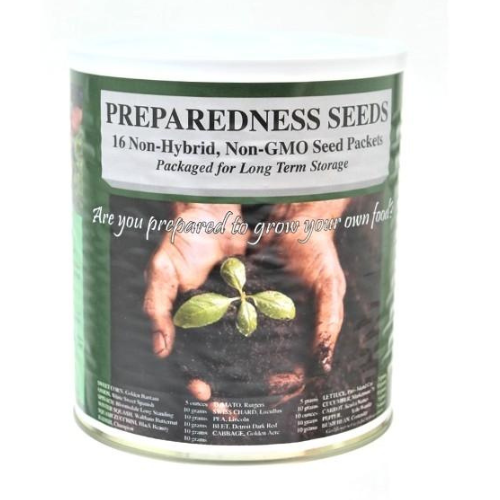
Quick heads up: Those sealed Preparedness Seeds cans listed below? They’re gone—the supplier went out of business.
Heirloom Seeds are the Answer
These Seeds are Non-Hybrid, Non-GMO, and are not chemically treated. Since they are non-hybrid, these seeds can be harvested at the end of the growing season and saved for planting the following year, providing a self-sustaining food source during tough times.
Heirloom Garden Seeds
The Preparedness Seeds Garden Vegetable Cans provide a missing link in your food storage plan. Each #10 can include 16 popular seed varieties, just enough to plant nearly 3/4 of an acre of garden!
16 large seed packets sealed in a #10 can.
- Plants nearly 3/4 acre of Garden.
- Packaged for long-term storage. See Shelf Life below.
- All Non-hybrid, open-pollinated varieties
- The equivalent of more than 100 average-size seed packets.
- Harvested seeds can be planted year after year.
- Packets are re-sealable for lasting protection.
- Complete planting instructions included.
Varieties of Vegetable Seeds included are:
SWEET CORN, Golden Bantam 5oz
ONION, Utah Sweet Spanish 10g
SPINACH, Bloomsdale Long Standing 10g
WINTER SQUASH, Waltham Butternut 10g
SQUASH ZUCCHINI, Black Beauty 10g
RADISH, Champion 10g
TOMATO, Rutgers 5g
SWISS CHARD, Lucullus 10g |
PEA, Lincoln 10oz
BEET, Detroit Dark Red 10g
CABBAGE, Golden Acre 10g
LETTUCE, Paris Island Cos 5g
CUCUMBER, Marketmore 76 10g
CARROT, Scarlet Nantes 10g
PEPPER, Yolo Wonder 5g
BUSH BEAN, Spike 5oz |
Shelf Life
While some non-hybrid seed companies advertise shelf lives of 20–100 years, this is only achievable under ideal conditions and often with reduced germination over time. Preparedness Seeds notes that their seeds remain viable for at least 4–5 years when stored at 70°F, and can last 10 years or more if kept in a refrigerator or freezer.
Properly dried seeds stored in a moisture-proof container can remain viable for up to 4 years at 65–70°F and can last significantly longer when kept at cooler temperatures. Each 6-degree drop in storage temperature may double the storage life of most seeds. Critical factors are temperature and moisture content. Store seeds in the coolest place possible, and keep cans sealed until you’re ready to use them. Keep unopened cans in a refrigerator or freezer, and always protect them from sunlight for optimal storage.
…If ye are prepared ye shall not fear…
The reality is clear – the future is unpredictable, and we live in uncertain times. Smart individuals are taking proactive steps to build and expand their food storage and supplies in preparation for potential shortages. People from all backgrounds, regardless of age or income, are filling their homes with buckets of wheat, oats, beans, and cans of freeze-dried meats and vegetables.
However, a year’s worth of food storage may not be sufficient to meet all of the body’s nutritional needs. And it is just a stopgap means to allow prepared people the time needed to plan for their future needs. A GARDEN is a must for the serious-minded person. For optimal health, the body needs—and benefits most from—the vitamins and nutrients found in fresh, living foods such as fruits and vegetables.
Planting Calendars by State
Gardeners across the United States often search for planting calendars specific to their region. Because climate zones vary widely, planting dates can be very different depending on where you live.
To simplify garden planning, planting calendars are now available for every state, helping gardeners quickly identify the best seed-starting dates for their specific region.
We suggest looking up planting or seed-starting schedules tailored to your state or local area, especially if you live in one of the following states: Other counties in Utah, Arizona, California, Colorado, Idaho, Montana, Nevada, New Mexico, Oregon, Washington, Wyoming, Illinois, Indiana, Iowa, Kansas, Michigan, Minnesota, Missouri, Nebraska, North Dakota, Ohio, South Dakota, Wisconsin, Alabama, Arkansas, Florida, Georgia, Kentucky, Louisiana, Mississippi, North Carolina, Oklahoma, South Carolina, Tennessee, Texas, Virginia, West Virginia, Connecticut, Delaware, Maine, Maryland, Massachusetts, New Hampshire, New Jersey, New York, Pennsylvania, Rhode Island, Vermont. Since climates and frost dates differ across the country, using a regional guide will provide more precise timing for sowing seeds and planting your garden.





Reviews
There are no reviews yet.